
Iranian Journal of Materials Science and Engineering
Iran University of Science & Technology
Fri, Sep 4, 2026
[Archive]


Volume 22, Issue 4 (December 2025)
IJMSE 2025, 22(4): 119-131 |
Back to browse issues page



Download citation:
BibTeX | RIS | EndNote | Medlars | ProCite | Reference Manager | RefWorks
Send citation to:


BibTeX | RIS | EndNote | Medlars | ProCite | Reference Manager | RefWorks
Send citation to:
N K J, M. K, M. G K, Vinjamuri V K, Kanakavalli P B, R.L K, et al . Effect Of Temperature on Ionic Conductivity and Optical Bandgap Features Of TSP-NaI-Based Biopolymer Electrolytes. IJMSE 2025; 22 (4) :119-131
URL: http://ijmse.iust.ac.ir/article-1-4086-en.html
URL: http://ijmse.iust.ac.ir/article-1-4086-en.html
Krishna Jyothi N 
 , Keerthi M. , Gnana Kiran M. , Venkata Kamesh Vinjamuri , Prakash Babu Kanakavalli , Krupakaran R.L , Nandini P.S.V. , Rao M.C. , D. Madhavi Latha , Mahamuda SK.
, Keerthi M. , Gnana Kiran M. , Venkata Kamesh Vinjamuri , Prakash Babu Kanakavalli , Krupakaran R.L , Nandini P.S.V. , Rao M.C. , D. Madhavi Latha , Mahamuda SK.
Abstract: (9069 Views)
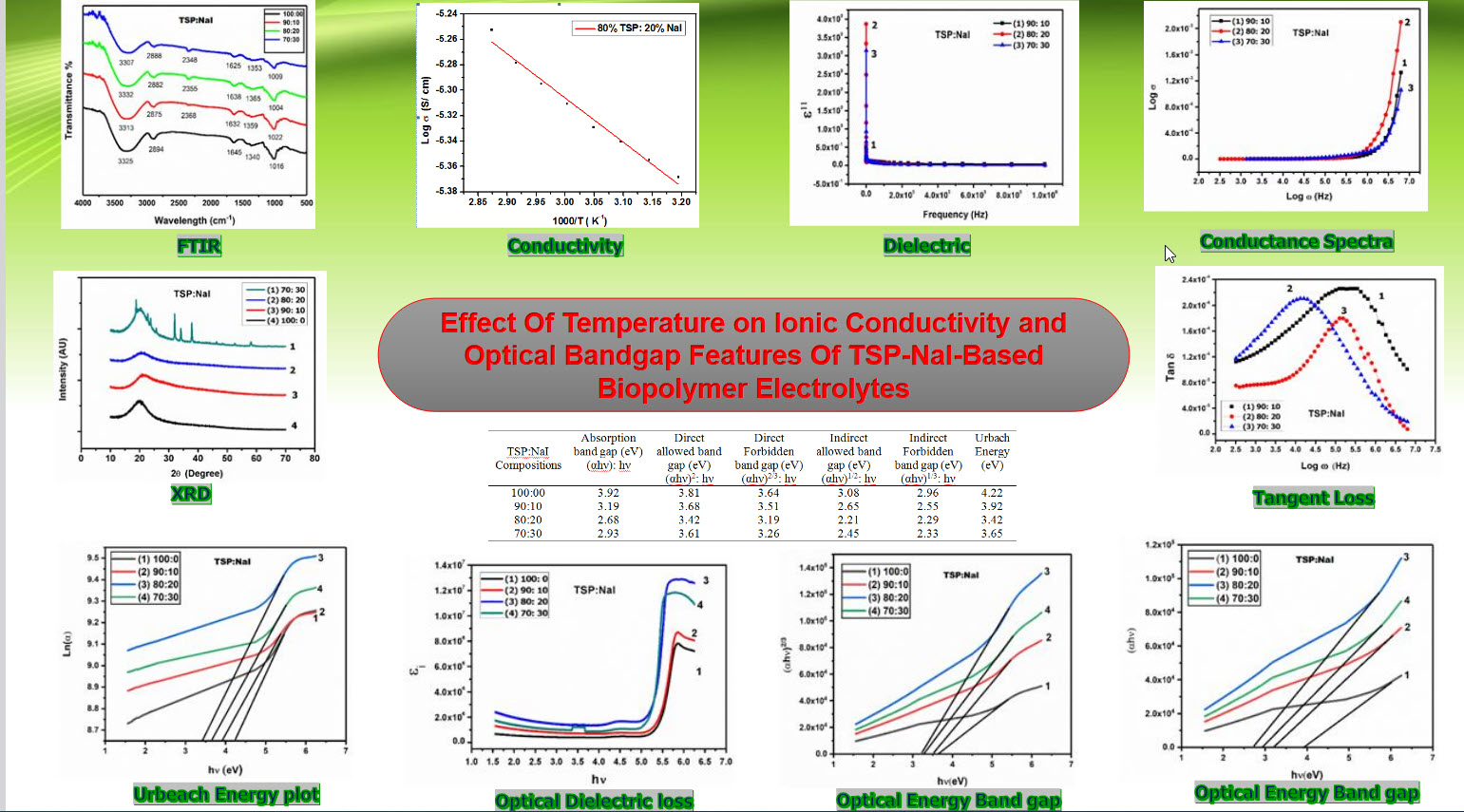
This research systematically examines the structural, electrical, and optical characteristics of Tamarind Seed Polysaccharide (TSP)--based biopolymer electrolytes that are doped with varying concentrations of sodium iodide (NaI). Composite films were synthesized using the solution cast technique in weight percent ratios of TSP: NaI (100:0, 90:10, 80:20, 70:30) and subsequently characterized employing X-ray diffraction (XRD), Fourier-transform infrared spectroscopy (FTIR), UV–Vis spectroscopy, and impedance analysis. The XRD analysis indicated that the 80:20 composition displayed the highest degree of amorphousness, which is associated with improved ionic conductivity and reduced crystallite size. The FTIR analysis corroborated the occurrence of complexation between TSP and NaI, while the temperature-dependent conductivity measurements conformed to Arrhenius behaviour, with the 80:20 film achieving the ionic conductivity (1.97x10⁻4 S/cm) and the lowest activation energy (0.69 eV). Optical absorption investigations revealed a decrease in the bandgap from 3.92 (pure TSP) to 2.68 eV (80:20 film). Minimum optical energy bandgaps were achieved for the optimized film. Opto-dielectric investigations further demonstrated that the 80:20 formulation exhibited optimal dielectric permittivity and loss. The results underscore the potential applicability of TSP–NaI biopolymer systems as sustainable, high-performance polymer electrolytes.
Type of Study: Research Paper |
Subject:
Ceramic Materials and Engineering
Send email to the article author
| Rights and permissions | |
 |
This work is licensed under a Creative Commons Attribution-NonCommercial 4.0 International License. |
